
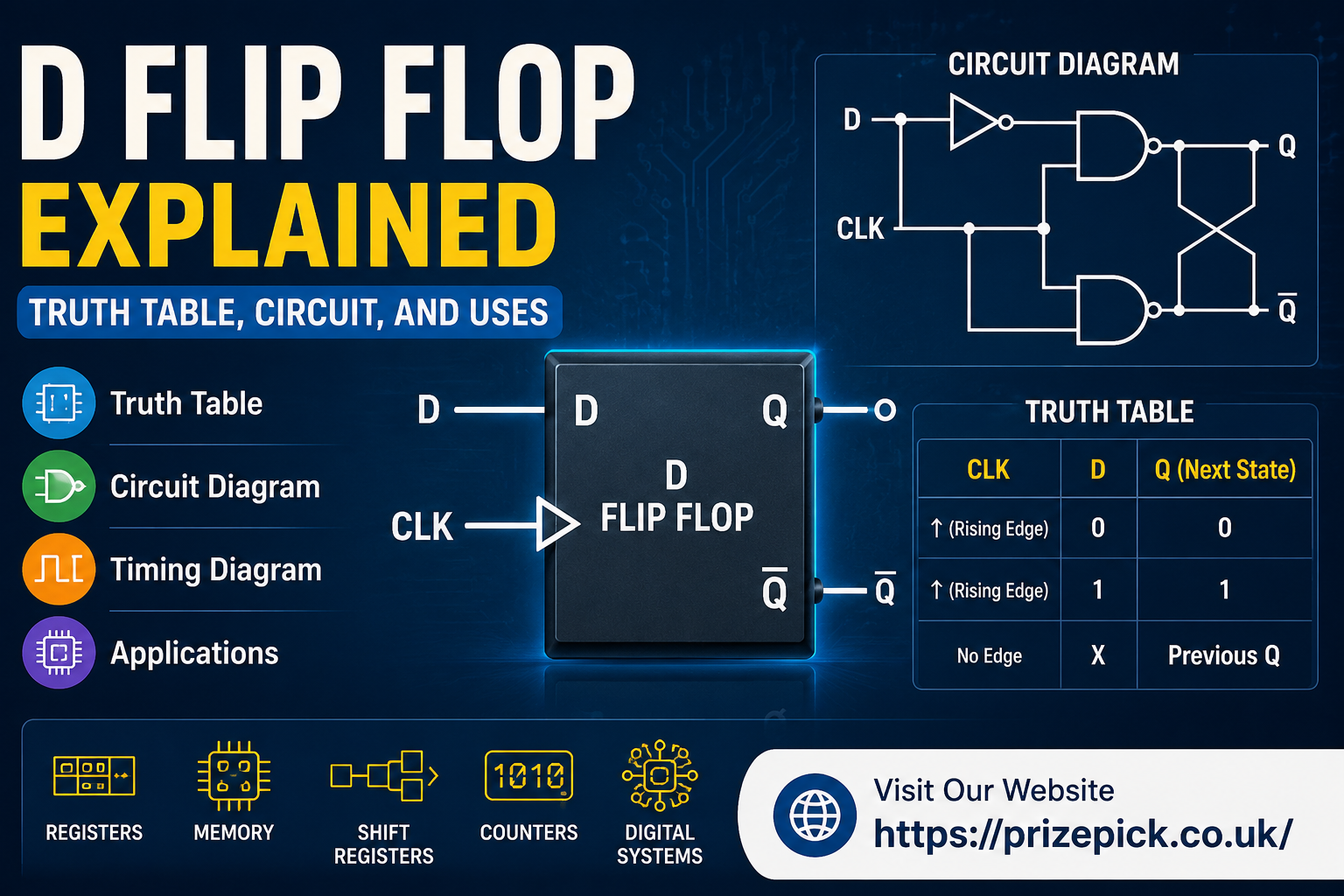
The D Flip Flop is one of the most important building blocks in digital electronics. Whether you’re studying computer engineering, designing digital circuits, or simply trying to understand how modern electronic devices store data, learning about the D Flip Flop is essential.
Unlike basic logic gates that produce outputs based only on current inputs, a D Flip Flop can remember information. This memory capability makes it a fundamental component in registers, counters, processors, communication systems, and many other digital devices.
What Is a D Flip Flop?
A D Flip Flop (Data Flip Flop or Delay Flip Flop) is a sequential logic circuit that stores exactly one bit of binary information. Unlike combinational logic circuits, sequential circuits have memory, meaning their output depends on both the current input and previous state.
The “D” stands for Data because the output simply follows the input data when triggered by the clock signal.
A D Flip Flop has one data input, one clock input, and two outputs:
- D – Data input
- CLK – Clock input
- Q – Normal output
- Q̅ (Q bar) – Complement output
The output changes only when the clock signal reaches its triggering edge, making the D Flip Flop highly reliable for synchronized digital systems.
Why Is a D Flip Flop Important?
Modern digital electronics depend on accurate data storage and synchronization.
The D Flip Flop provides several important benefits:
- Stores digital information reliably
- Synchronizes operations using a clock
- Prevents unwanted output changes
- Simplifies circuit design
- Eliminates invalid input combinations found in SR flip flops
Without D Flip Flops, devices such as computers, smartphones, calculators, and communication systems would not function correctly.
Basic Symbol of a D Flip Flop
A standard D Flip Flop contains:
| Pin | Function |
|---|---|
| D | Data input |
| CLK | Clock signal |
| Q | Stored output |
| Q̅ | Inverted output |
Many integrated circuits also include:
- Preset (PRE)
- Clear (CLR)
These inputs allow manual setting or resetting regardless of the clock.
How Does a D Flip Flop Work?
The D Flip Flop copies the value present at the D input to the output only when the clock is triggered.
For example:
- If D = 1 during the active clock edge, then Q becomes 1.
- If D = 0 during the active clock edge, then Q becomes 0.
Between clock pulses, the output remains unchanged even if the input changes.
This behavior makes the D Flip Flop ideal for storing stable digital information.
D Flip Flop Truth Table
The following truth table assumes a positive-edge-triggered D Flip Flop.
| Clock | D | Q (Next State) |
|---|---|---|
| Rising Edge | 0 | 0 |
| Rising Edge | 1 | 1 |
| No Edge | X | Previous Q |
X means the input can be either 0 or 1 because it does not affect the stored value when there is no triggering clock edge.
D Flip Flop Characteristic Equation
The characteristic equation is extremely simple:
Q(next) = D
This means the next output state equals the data input at the triggering clock edge.
D Flip Flop Circuit
A D Flip Flop is commonly built from an SR latch with additional logic gates that ensure the Set and Reset inputs can never become active simultaneously.
The circuit generally includes:
- Two NAND gates or NOR gates
- Clock input
- Data input
- Cross-coupled latch
Modern integrated circuits combine these elements into a compact package.
Timing Diagram Explained
The timing diagram illustrates exactly when the output changes.
Example
Suppose the data input changes several times.
Clock:  ↑     ↑     ↑
D:       1 0 1 1 0
Q:       1 0 1
Notice that Q updates only at the rising edge of the clock.
Any changes between clock pulses are ignored.
This synchronized operation is one reason D Flip Flops are widely used in digital design.
Types of D Flip Flops
Edge-Triggered D Flip Flop
Updates output only during the rising or falling clock edge.
Advantages:
- High reliability
- Excellent synchronization
- Commonly used in processors
Level-Triggered D Latch
Sometimes confused with a D Flip Flop.
Differences:
- Active while clock remains high (or low)
- Output follows input during active clock level
- Simpler but more susceptible to unwanted changes
D Flip Flop vs D Latch
| Feature | D Flip Flop | D Latch |
|---|---|---|
| Trigger | Clock edge | Clock level |
| Data Storage | Stable | Transparent during enable |
| Synchronization | Better | Simpler |
| Usage | CPUs, registers | Temporary storage |
D Flip Flop vs SR Flip Flop
| Feature | D Flip Flop | SR Flip Flop |
|---|---|---|
| Inputs | One data input | Set and Reset inputs |
| Invalid State | None | Possible |
| Ease of Use | Easier | More complex |
| Reliability | High | Moderate |
The D Flip Flop was largely developed to eliminate the invalid input condition of the SR Flip Flop.
Advantages of D Flip Flop
Some major advantages include:
- Simple operation
- Reliable data storage
- Synchronizes with clock
- Eliminates invalid input combinations
- Low error rate
- Widely supported in integrated circuits
- Easy to combine into larger systems
Limitations of D Flip Flop
Although useful, D Flip Flops also have limitations:
- Requires a clock signal
- Slight propagation delay
- Uses more hardware than simple latches
- High-speed systems require careful timing analysis
Practical Applications of D Flip Flop
D Flip Flops appear in nearly every digital electronic system.
1. Registers
Registers temporarily store binary information inside CPUs and microcontrollers.
2. Memory Devices
Many memory architectures use D Flip Flops for temporary data storage.
3. Shift Registers
Used to move data serially or in parallel.
Applications include:
- Communication systems
- Data transmission
- Signal processing
4. Counters
Binary counters rely on cascaded flip flops.
Examples include:
- Digital clocks
- Frequency counters
- Timers
5. Frequency Division
A D Flip Flop can divide an input clock frequency by two.
This is useful in digital timing circuits.
6. Finite State Machines
Control systems often use D Flip Flops to store the current state before transitioning to the next.
7. Microprocessors
Every processor contains thousands or even millions of flip flops that help execute instructions reliably.
Real-World Example
Imagine a digital calculator.
When you press the number 5, the system must temporarily store that value before performing calculations.
The D Flip Flop stores this bit of information until the next clock cycle updates the circuit.
Without flip flops, digital devices would lose information almost instantly.
Design Considerations
When designing circuits using D Flip Flop, engineers consider:
- Setup time
- Hold time
- Clock skew
- Propagation delay
- Clock frequency
- Power consumption
Ignoring these factors may cause incorrect data storage or timing errors.
Common Mistakes Beginners Make
When learning D Flip Flops, students often:
- Confuse latches with flip flops
- Forget that output changes only at the clock edge
- Misread timing diagrams
- Ignore setup and hold time requirements
- Assume the output always follows the input immediately
Understanding these concepts early makes digital circuit design much easier.
Frequently Asked Questions
1. What does the “D” in D Flip Flop stand for?
The “D” stands for Data or Delay, indicating that the input data is transferred to the output on the active clock edge.
2. What is the main purpose of a D Flip Flop?
Its primary purpose is to store one bit of digital data in synchronized electronic circuits.
3. What is the difference between a D Flip Flop and a D latch?
A D Flip Flop changes output only on a clock edge, while a D latch remains transparent during an active clock level.
4. Why is a clock signal required?
The clock ensures that all flip flops in a digital system update simultaneously, preventing unpredictable behavior.
5. Where are D Flip Flops commonly used?
They are used in processors, memory units, shift registers, counters, communication systems, and digital control circuits.
6. Can a D Flip Flop store data permanently?
No. It stores data only while power is supplied. Permanent storage requires non-volatile memory technologies.
7. Why is the D Flip Flop preferred over the SR Flip Flop?
It eliminates the invalid input condition of the SR Flip Flop, making circuit design simpler and more reliable.
Conclusion
The D Flip Flop is a cornerstone of digital electronics, providing a simple yet dependable way to store and synchronize binary data. Its edge-triggered operation ensures predictable performance, making it indispensable in processors, memory systems, registers, counters, and countless other digital circuits.
By understanding its truth table, characteristic equation, timing behavior, and practical applications, students, engineers, and electronics enthusiasts can build a strong foundation in sequential logic design. Whether you’re studying digital systems or developing real-world electronic devices, mastering the D Flip Flop is an essential step toward understanding how modern computing hardware works.