
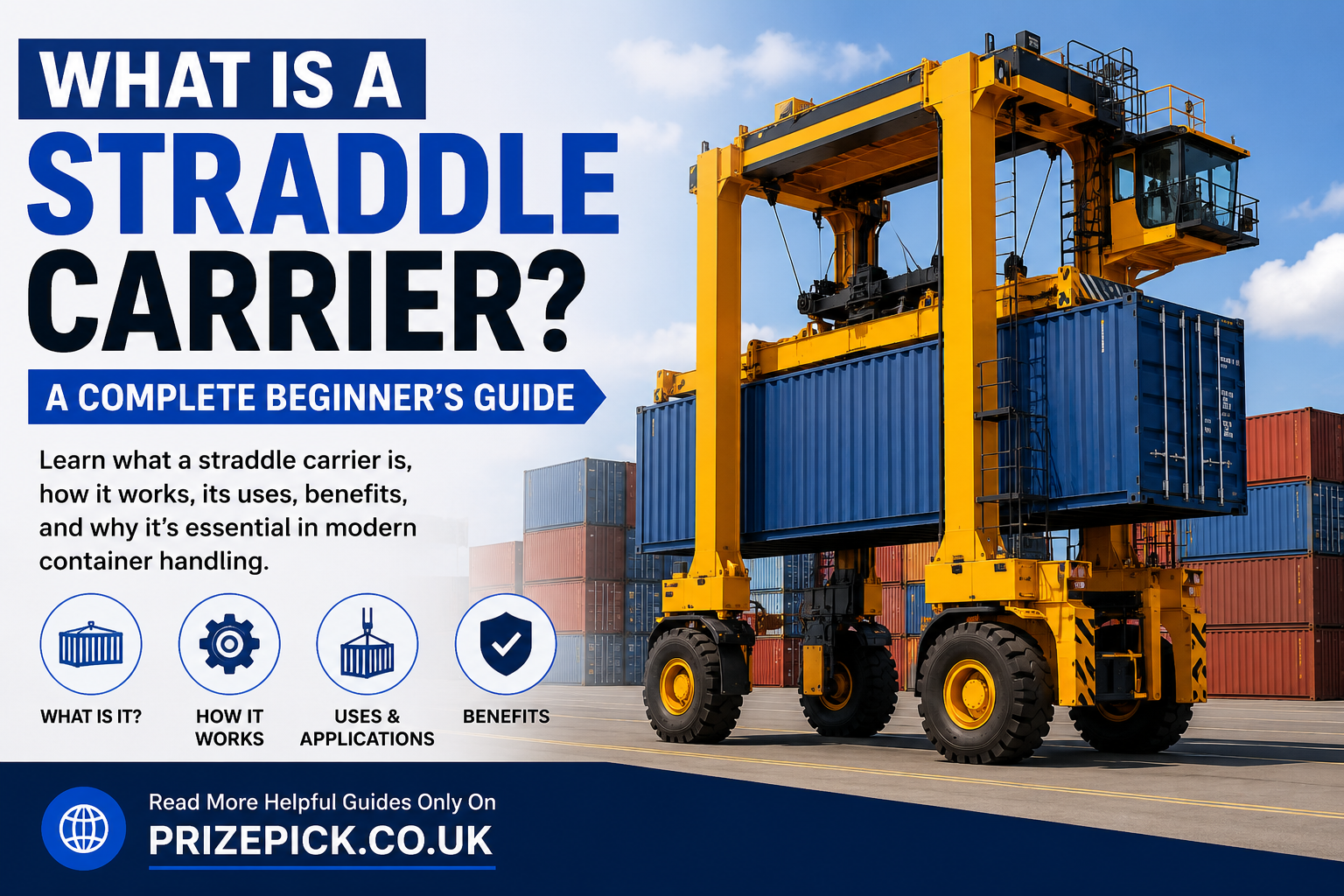
A Straddle Carrier is one of the most important machines used in modern ports, container terminals, and logistics hubs. Designed to lift, transport, and stack shipping containers, this specialized vehicle plays a critical role in keeping global trade moving efficiently.
If you’ve ever wondered how thousands of shipping containers are moved every day without causing delays, the answer often involves a Straddle Carrier. These powerful machines can lift containers beneath their frame, transport them across terminals, and stack them with remarkable precision. Their ability to perform multiple tasks with speed and accuracy makes them an essential part of today’s container handling operations.
What Is a Straddle Carrier?
A Straddle Carrier is a large rubber-tired vehicle built specifically to handle intermodal shipping containers. Unlike cranes or forklifts, it drives directly over a container, lifts it using a spreader attached to its upper frame, and transports it without requiring additional lifting equipment.
Because the container is carried beneath the machine, operators enjoy excellent maneuverability while maximizing available yard space.
Today, Straddle Carrier are commonly found at:
- Shipping ports
- Container terminals
- Rail freight terminals
- Distribution centers
- Intermodal logistics facilities
They are considered one of the most efficient methods for moving containers over short to medium distances.
How Does a Straddle Carrier Work?
The operating principle is straightforward yet highly effective.
Positioning
The operator drives the machine directly over the shipping container.
Container Locking
A spreader beam lowers onto the container and securely locks into its corner castings using twist-lock mechanisms.
Lifting
Hydraulic systems raise the container safely beneath the vehicle.
Transportation
The Straddle Carrier moves the suspended container to its destination.
Placement
The operator lowers the container onto the ground, a trailer, railway wagon, or another container.
This streamlined process minimizes handling time and reduces dependence on multiple pieces of equipment.
Main Components of a Straddle Carrier
Several systems work together to ensure reliable operation.
| Component | Purpose |
|---|---|
| Steel Frame | Supports the entire machine |
| Spreader | Grips and lifts containers |
| Hydraulic System | Controls lifting operations |
| Diesel or Electric Engine | Provides driving power |
| Wheels and Steering System | Enables movement and maneuverability |
| Operator Cabin | Houses controls and monitoring systems |
| Safety Sensors | Help prevent collisions and accidents |
Modern Straddle Carriers often include GPS navigation, cameras, automation features, and remote monitoring technologies.
Types of Straddle Carriers
Different operations require different machine configurations.
Single-Stack Straddle Carrier
These machines transport containers but generally stack only one container high. They are suitable for smaller terminals with limited storage needs.
Two-High Straddle Carrier
These models can stack containers two levels high while maintaining efficient transport capabilities.
Three-High Straddle Carrier
Designed for larger container yards, these machines maximize storage capacity by stacking containers three high.
Automated Straddle Carrier
Many advanced ports now use automated or semi-automated Straddle Carriers that operate with minimal human intervention. These systems improve consistency, reduce labor requirements, and enhance safety.
Where Are Straddle Carriers Used?
Straddle Carriers serve many industries involved in freight movement.
Container Ports
Large seaports use them to move containers between ships, storage yards, and transport vehicles.
Rail Terminals
They efficiently transfer containers between trains and trucks.
Logistics Parks
Distribution centers use them to organize container storage before onward transportation.
Intermodal Freight Facilities
They simplify transfers between different transportation modes while reducing delays.
Benefits of Using a Straddle Carrier
Organizations choose Straddle Carriers because they provide numerous operational advantages.
Faster Container Movement
Since one machine can lift, transport, and stack containers, fewer handling steps are required.
Better Space Utilization
Containers can be stacked vertically, allowing terminals to store more cargo in limited areas.
Increased Productivity
Operators complete more container movements per hour compared to many traditional methods.
Lower Equipment Requirements
Unlike systems that require separate cranes and transport vehicles, a Straddle Carrier combines several functions into one machine.
Improved Flexibility
They can operate across large terminal areas without relying on fixed infrastructure.
Straddle Carrier vs Reach Stacker
Although both machines move containers, they serve different purposes.
| Feature | Straddle Carrier | Reach Stacker |
| Container Position | Under the machine | In front of the machine |
| Best Use | Large container terminals | Smaller yards |
| Storage Capacity | High | Moderate |
| Travel Efficiency | Excellent | Good |
| Space Utilization | Very efficient | Requires wider aisles |
| Productivity | High-volume operations | Medium-volume operations |
Large ports often prefer Straddle Carriers because they provide faster movement and greater storage efficiency.
Common Industries That Depend on Straddle Carriers
Many sectors rely on these machines to maintain efficient supply chains.
Examples include:
- International shipping
- Maritime logistics
- Freight forwarding
- Manufacturing
- Import and export operations
- Retail distribution
- Automotive logistics
As global trade continues to expand, demand for efficient container handling equipment remains strong.
Safety Features
Safety is a major consideration during container handling.
Modern Straddle Carriers often include:
- Collision avoidance systems
- Anti-sway technology
- Load monitoring sensors
- Emergency braking systems
- Camera systems
- Operator assistance displays
- Stability control
Regular operator training further reduces workplace risks.
Maintenance Requirements
Routine maintenance keeps a Straddle Carrier operating efficiently and safely.
Important maintenance tasks include:
- Hydraulic system inspections
- Tire condition checks
- Brake testing
- Engine servicing
- Lubrication of moving parts
- Electrical system diagnostics
- Spreader inspection
- Safety system testing
Preventive maintenance helps reduce downtime and extends equipment lifespan.
Environmental Considerations
Many manufacturers now produce electric and hybrid Straddle Carrier to reduce emissions and fuel consumption.
These environmentally friendly models offer several advantages:
- Lower operating costs
- Reduced carbon emissions
- Quieter operation
- Lower maintenance requirements
- Improved energy efficiency
As ports pursue sustainability goals, electric equipment is becoming increasingly common.
Factors to Consider Before Buying a Straddle Carrier
Choosing the right machine depends on operational requirements.
Consider:
- Container handling volume
- Required lifting capacity
- Maximum stacking height
- Yard layout
- Fuel or electric power options
- Maintenance support
- Operator training needs
- Total cost of ownership
A thorough assessment ensures the equipment matches long-term operational goals.
Future of Straddle Carriers
Container terminals continue to adopt advanced technologies that improve efficiency.
Future developments include:
- Autonomous operation
- Artificial vision systems
- Remote fleet management
- Predictive maintenance
- Battery-electric powertrains
- Improved energy efficiency
- Smart traffic coordination
These innovations are expected to make container handling safer, faster, and more sustainable.
Frequently Asked Questions
1. What is a Straddle Carrier used for?
A Straddle Carrier is used to lift, transport, and stack shipping containers in ports, rail terminals, and logistics facilities.
2. How much weight can a Straddle Carrier lift?
Most models handle standard 20-foot and 40-foot containers weighing up to several dozen metric tons, depending on their design and capacity.
3. What is the difference between a Straddle Carrier and a forklift?
A Straddle Carrier is specifically designed for shipping containers and carries them beneath its frame, while forklifts primarily handle palletized goods and lighter cargo.
4. Are Straddle Carriers electric?
Both diesel-powered and electric models are available. Many modern terminals are adopting electric versions to reduce emissions and operating costs.
5. Why are Straddle Carriers important in ports?
They increase efficiency by combining lifting, transportation, and stacking into a single operation, reducing congestion and improving container flow.
6. How high can a Straddle Carrier stack containers?
Depending on the model, they can stack containers one, two, or even three levels high.
7. Do Straddle Carriers require specially trained operators?
Yes. Operators receive specialized training to safely handle heavy containers, navigate busy terminals, and use onboard safety systems effectively.
Conclusion
A Straddle Carrier is a cornerstone of modern container handling, enabling ports, terminals, and logistics centers to move cargo quickly, safely, and efficiently. By combining lifting, transporting, and stacking into a single machine, it reduces operational complexity while increasing productivity and making better use of valuable storage space.
Whether you’re a logistics professional, engineering student, or simply curious about how global trade works, understanding the role of a Straddle Carrier provides valuable insight into one of the world’s most important pieces of cargo-handling equipment. As technology advances with automation and electric powertrains, Straddle Carriers will continue to play a vital role in building faster, safer, and more sustainable supply chains.