
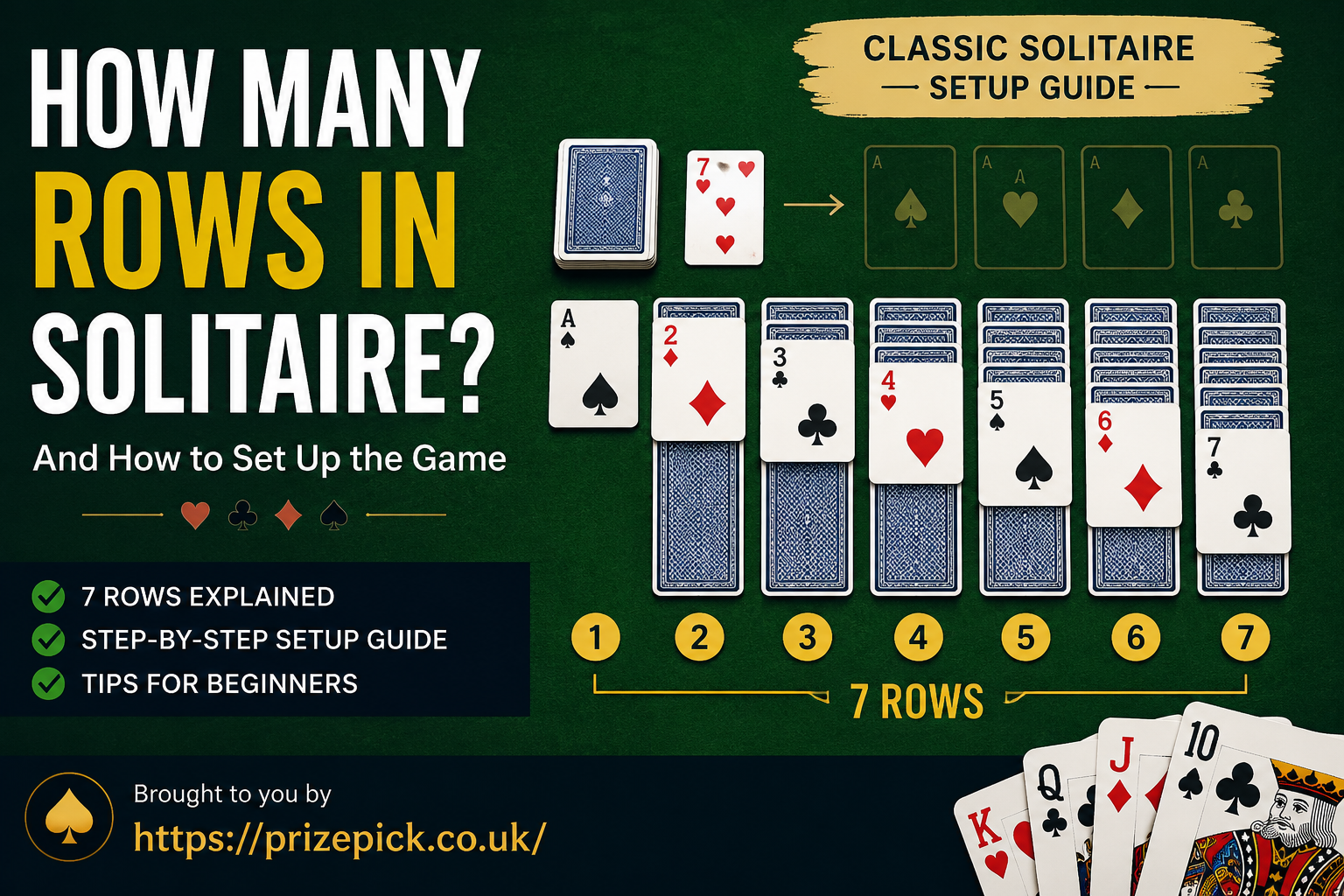
If you’re learning to play Solitaire, one of the first questions you’ll probably ask is, how many rows in Solitaire are there? It may seem like a small detail, but arranging the cards correctly is essential for playing the game according to the official rules.
Classic Solitaire—also known as Klondike Solitaire—has a specific tableau layout that determines how the game begins. A proper setup ensures fair gameplay and helps you develop effective strategies as you learn.
How Many Rows in Solitaire?
The answer is straightforward:
Classic Klondike Solitaire has 7 rows.
These seven rows form what’s known as the tableau, the main playing area where most of the game takes place.
Each row contains a different number of cards:
| Row | Number of Cards | Face-Up Cards |
|---|---|---|
| 1 | 1 | 1 |
| 2 | 2 | 1 |
| 3 | 3 | 1 |
| 4 | 4 | 1 |
| 5 | 5 | 1 |
| 6 | 6 | 1 |
| 7 | 7 | 1 |
This setup uses 28 cards in total.
The remaining 24 cards are placed in the stock pile, which players draw from during the game.
Understanding the Solitaire Layout
Before setting up the game, it’s helpful to understand the four main areas of a How Many Rows in Solitaire board.
Tableau
The tableau consists of the seven rows where cards are arranged in descending order while alternating colors.
Stock
The stock contains the unused cards after the tableau has been created.
Players draw cards from this pile when no other moves are available.
Waste Pile
Cards drawn from the stock are placed in the waste pile.
Depending on the game rules, players may draw one or three cards at a time.
Foundation Piles
There are four foundation piles—one for each suit.
The objective is to build each pile from Ace through King.
How to Set Up Solitaire Step by Step
Setting up Solitaire correctly takes only a minute.
Shuffle the Deck
Use a standard deck of 52 playing cards without jokers.
Shuffle thoroughly.
Create Seven Rows
Lay out the cards from left to right.
- Row 1 receives one card.
- Row 2 receives two cards.
- Row 3 receives three cards.
- Continue until Row 7 has seven cards.
Turn Over the Top Cards
Only the top card of each row should face upward.
Every card underneath remains face down.
Make the Stock Pile
After creating the tableau, place all remaining cards face down.
This becomes the stock pile.
Leave Space for Foundations
Above the tableau, leave room for four foundation piles.
These start empty.
Your Solitaire game is now ready to play.
Visual Breakdown of the Tableau
The layout looks like this:
| Row | Cards | Face Up |
|---|---|---|
| 1 | 1 | Top card |
| 2 | 2 | Top card |
| 3 | 3 | Top card |
| 4 | 4 | Top card |
| 5 | 5 | Top card |
| 6 | 6 | Top card |
| 7 | 7 | Top card |
Total cards in tableau:
1 + 2 + 3 + 4 + 5 + 6 + 7 = 28 cards
Remaining cards:
52 − 28 = 24 cards in the stock
Why Does Solitaire Use Seven Rows?
The seven-row layout creates a balance between challenge and strategy.
It ensures:
- Hidden cards create uncertainty.
- Multiple columns allow different move options.
- Players must reveal hidden cards strategically.
- Every game begins with the same structural rules while the shuffled deck keeps each game unique.
Without seven rows, Klondike how many rows in Solitaire would lose much of its strategic depth.
How Gameplay Begins
Once the game starts, your goal is to uncover hidden cards while building the foundation piles.
Players typically begin by:
- Looking for Aces.
- Moving cards between tableau columns.
- Revealing face-down cards whenever possible.
- Drawing from the stock when no tableau moves remain.
The game ends successfully when all four foundation piles contain cards from Ace through King.
Common Solitaire Setup Mistakes
Many beginners accidentally set up the game incorrectly.
Avoid these common errors:
Using the Wrong Number of Rows
Some players mistakenly create six or eight rows.
Classic Klondike always uses seven.
Turning Too Many Cards Face Up
Only the top card in each row should be visible at the start.
Forgetting the Stock Pile
The leftover 24 cards should remain face down in a separate stack.
Uneven Card Distribution
Each row must contain exactly one more card than the previous row.
Solitaire Variations Have Different Layouts
Not every Solitaire game follows the Klondike setup.
| Solitaire Variant | Tableau Layout |
|---|---|
| Klondike | 7 rows |
| Spider Solitaire | 10 columns |
| FreeCell | 8 columns |
| Pyramid Solitaire | 7 overlapping rows in a pyramid |
| Yukon | 7 columns with a different card distribution |
If you’re playing online, check which version you’re using because the setup rules may differ.
Tips for New Solitaire Players
Learning proper setup is only the first step. These tips can improve your gameplay:
- Reveal hidden cards as early as possible.
- Avoid moving cards without a purpose.
- Build foundation piles steadily rather than rushing.
- Keep tableau columns flexible for Kings.
- Think several moves ahead before drawing from the stock.
Practicing these habits will improve your chances of winning over time.
Does Playing Digitally Change the Number of Rows?
No.
Whether you’re playing:
- Microsoft Solitaire
- Mobile Solitaire apps
- Browser-based Solitaire
- A physical card game
Classic Klondike still begins with seven rows.
Digital versions automatically deal the cards, but they follow the same standard layout used in the traditional game.
Why the Correct Setup Matters
A correct setup does more than follow the rules.
It also:
- Ensures fair gameplay.
- Makes strategy consistent.
- Prevents impossible game states caused by incorrect dealing.
- Helps players learn the official version of Solitaire.
- Makes it easier to compare strategies with guides and tutorials.
Understanding the proper layout builds a strong foundation for improving your Solitaire skills.
Frequently Asked Questions
1. How many rows are in classic Solitaire?
Classic Klondike Solitaire uses 7 rows in the tableau.
2. How many cards are used in the tableau?
The tableau contains 28 cards, arranged across seven rows.
3. How many cards remain in the stock pile?
After the tableau is created, 24 cards remain in the stock pile.
4. Why is only one card face up in each row?
This creates hidden information, making the game more strategic and requiring players to uncover cards as they progress.
5. Are all Solitaire games set up with seven rows?
No. While Klondike uses seven rows, other versions like Spider Solitaire and FreeCell use different layouts and rules.
6. Can I play Solitaire with a regular deck of cards?
Yes. A standard 52-card deck without jokers is all you need to play classic Klondike Solitaire.
7. Does drawing one or three cards change the setup?
No. The initial layout remains the same. The draw rule only affects how cards are taken from the stock during play.
Conclusion
If you’ve been wondering how many rows in Solitaire are used in the classic game, the answer is simple: seven. These seven rows form the tableau, using 28 cards arranged in increasing order from one to seven, with only the top card of each row face up. The remaining 24 cards become the stock pile.
Learning the correct setup is the first step toward mastering Klondike Solitaire. Once you understand the layout, you’ll be better prepared to develop winning strategies, reveal hidden cards efficiently, and enjoy the game as it was designed to be played. Whether you’re using a physical deck or a digital app, following the official seven-row setup ensures every game starts on the right foot.