
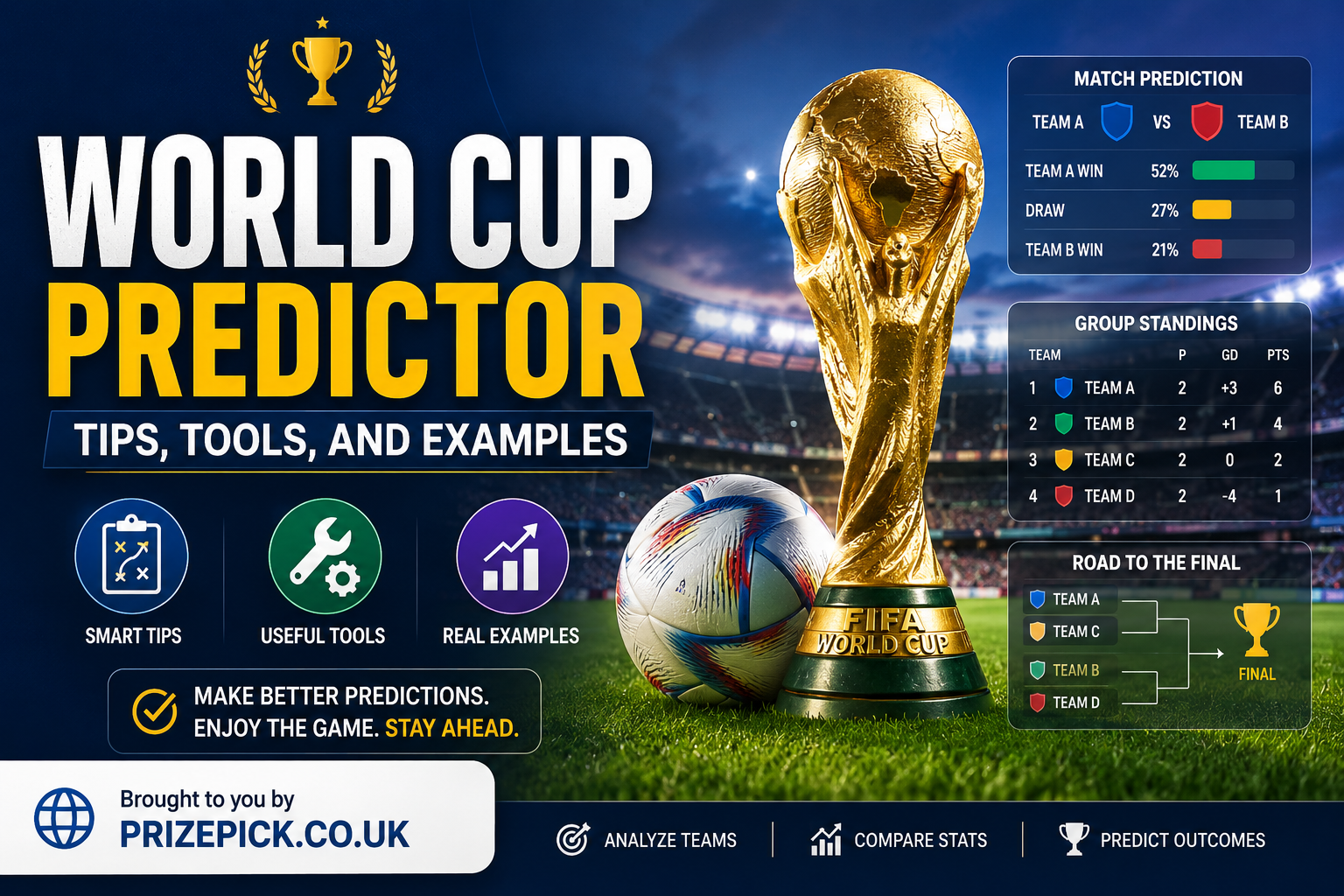
Predicting the outcome of a World Cup is part statistics, part football knowledge, and part uncertainty. Even the strongest teams can struggle against well-organized opponents, while an underdog can change an entire tournament with one unexpected result. That is why a World Cup Predictor can be useful for fans who want a structured way to assess matches rather than relying only on instinct.
A predictor can estimate the likely winner of a match, expected score, group standings, knockout progression, or even the eventual tournament champion. Different tools use different information, including team strength, recent performances, home or neutral conditions, goals scored, defensive records, injuries, and historical results.
However, no predictor can guarantee an outcome. Football contains too many variables for any model to remove uncertainty completely.
What Is a World Cup Predictor?
A World Cup Predictor is a tool, model, or method used to estimate the likely outcomes of World Cup matches or the tournament as a whole.
Depending on the system, it may predict:
- Match winners
- Draw probabilities
- Expected scores
- Group-stage standings
- Teams likely to reach the knockout rounds
- Quarter-finalists and semi-finalists
- Finalists
- Potential tournament winners
Some predictors are simple. For example, a fan might compare two teams based on their recent results and decide which side appears stronger.
More advanced prediction models can process many variables and convert them into probabilities. Instead of simply saying that Team A will win, a model might estimate a 55% chance of a Team A victory, a 25% chance of a draw, and a 20% chance of a Team B victory.
That distinction is important because probability reflects uncertainty.
How Does a World Cup Predictor Work?
There is no single formula used by every prediction tool. Different models can produce different results because they use different datasets, assumptions, and statistical techniques.
A typical prediction process may involve several stages.
1. Assessing Team Strength
A model first needs some way to measure how strong each team is.
Possible indicators include:
- International rankings
- Recent competitive results
- Strength of opponents faced
- Goal difference
- Defensive record
- Attacking output
- Tournament experience
Team strength should ideally be considered in context. Winning five matches against weaker opponents does not necessarily indicate the same level of strength as winning three difficult matches against elite teams.
2. Examining Recent Form
Recent performances can provide useful information about a team’s current level.
For example, a team that has recently improved defensively may be more difficult to beat than its longer-term record suggests.
However, form should not be treated as the only factor. A short winning streak can sometimes be misleading because of the quality of opposition, match circumstances, or limited sample size.
3. Comparing Attack and Defence
Goals scored and goals conceded are particularly useful when evaluating football teams.
A strong attacking team may create numerous scoring opportunities, while a disciplined defensive team may reduce the opponent’s chances.
A balanced predictor should consider both sides.
For example:
| Factor | Team A | Team B |
|---|---|---|
| Recent attacking form | Strong | Moderate |
| Defensive record | Moderate | Strong |
| Recent results | Strong | Strong |
| Squad depth | Strong | Moderate |
| Overall assessment | Slight advantage | Competitive |
This does not automatically mean Team A will win. It simply suggests that Team A may have a statistical advantage.
What Data Should a World Cup Predictor Consider?
The quality of a prediction depends heavily on the quality and relevance of the information being used.
Team Rankings and Ratings
Ratings can provide a useful baseline for comparing teams. They help establish an estimate of relative strength before individual match factors are considered.
Recent Results
Recent competitive matches can reveal changes in performance, although they should be interpreted alongside the quality of the opposition.
Goals and Expected Performance
Goals scored and conceded can indicate attacking and defensive strength. More sophisticated approaches may also examine shot quality, chances created, and other performance indicators.
Squad Availability
Injuries, suspensions, and player availability can significantly influence a match.
Losing an important goalkeeper, central defender, midfielder, or striker may affect a team’s expected performance. A good predictor should account for meaningful squad changes when reliable information is available.
Tournament Context
A World Cup match cannot always be evaluated in isolation.
A team may need a win to advance, while another team may only require a draw. Knockout matches also have different strategic dynamics from group-stage games.
World Cup Predictor Tips for Better Results
If you are using a prediction tool or building your own forecasts, a few principles can make the process more useful.
Look Beyond the Last Match
One recent result rarely tells the whole story.
A team may lose because of an early red card, an unusual number of missed chances, or a particularly strong opponent. Similarly, a narrow win does not necessarily mean a team performed poorly.
Look for patterns across multiple matches.
Consider the Quality of Opposition
A team’s record should always be viewed in context.
Suppose Team A has won four of its last five matches against relatively weak opponents, while Team B has won three of its last five against highly ranked teams.
The raw win totals favor Team A, but the underlying comparison may be much closer.
Avoid Overvaluing Historical Head-to-Head Records
Previous meetings can be interesting, but older results may have limited predictive value.
Players, coaches, tactics, and team quality change. A match played several years earlier may tell you very little about the current squads.
Historical data works best when combined with more relevant recent information.
Use Probabilities Instead of Certainties
One of the biggest mistakes in football prediction is treating a probability as a guarantee.
If a model gives a team a 70% chance of winning, that still leaves a 30% probability of another outcome.
A 70% prediction should therefore be understood as “more likely,” not “certain.”
A Simple World Cup Prediction Example
Imagine a hypothetical group-stage match between Team A and Team B.
Suppose your analysis produces these estimates:
| Outcome | Estimated Probability |
| Team A wins | 52% |
| Draw | 27% |
| Team B wins | 21% |
The prediction favors Team A, but the result is far from certain.
A useful analysis would then ask why Team A has the advantage.
Perhaps Team A has:
- Better recent defensive numbers
- More consistent attacking output
- Greater squad depth
- Stronger performances against comparable opponents
At the same time, Team B may have strengths that could change the match, such as an effective counter-attacking style or an exceptional goalkeeper.
The final prediction should acknowledge both the statistical advantage and the uncertainty.
How to Evaluate a World Cup Predictor
A predictor should not be judged simply by whether one prediction was correct.
Football outcomes contain randomness, so even a well-designed model will make mistakes.
Instead, consider several factors.
Accuracy Over a Large Sample
A model should ideally be evaluated across many matches rather than a handful of games.
One correct prediction does not prove that a system is reliable, just as one incorrect prediction does not automatically make it useless.
Calibration
Calibration asks whether predicted probabilities correspond reasonably well with actual outcomes over time.
For example, if a model regularly assigns matches a 70% winning probability, those predictions should eventually produce results that are broadly consistent with that probability level.
Transparency
A useful predictor should make it reasonably clear what factors influence its predictions.
Transparency makes it easier for users to understand both the strengths and limitations of the model.
Common Mistakes When Using Prediction Tools
Even a sophisticated predictor can be misused.
Treating the Prediction as Certain
No football model eliminates uncertainty.
Ignoring New Information
A prediction made before a major injury or lineup change may become less relevant after the situation changes.
Focusing Only on Rankings
Rankings are useful, but they do not capture every factor that can influence a specific match.
Overreacting to One Performance
A single excellent or poor match should not automatically change your entire assessment.
Confusing Entertainment With Reliability
Some online prediction tools are designed primarily for fan engagement. Others use statistical models. Understanding the purpose and methodology of a tool helps you interpret its results appropriately.
World Cup Predictor Tools: What Should You Look For?
If you are comparing different prediction tools, consider whether they provide:
- Clear methodology — You should understand what information influences the prediction.
- Useful probabilities — Win, draw, and loss estimates are more informative than unsupported certainty.
- Relevant data — Current team performance matters more than outdated information.
- Regular updates — Predictions can change when squad or tournament circumstances change.
- Historical performance — Where available, past model performance can help evaluate reliability.
- Simple presentation — A useful tool should make its results easy to understand.
Can a World Cup Predictor Predict the Winner?
Yes, a predictor can estimate which team has the highest probability of winning the tournament.
However, tournament predictions are more complicated than predicting a single match.
A model may need to account for:
- Group-stage performance
- Potential knockout opponents
- Tournament bracket structure
- Team strength
- Match probabilities
- Injuries and squad changes
- Extra-time and penalty-shootout possibilities
A team with the highest overall tournament probability does not necessarily win. The knockout format creates many opportunities for unexpected results.
Why Predictions Can Still Be Wrong
Football is inherently difficult to forecast.
A single moment can change a match. A penalty, red card, deflection, goalkeeper error, injury, World Cup Predictor or late goal can completely alter the expected outcome.
This is why responsible prediction focuses on probabilities rather than certainty.
The goal is not to produce a perfect forecast. The goal is to make a structured assessment using the best available information.
How to Make Your Own World Cup Predictions
You do not need an advanced statistical model to make a structured prediction.
Try this simple process:
- Compare the teams’ overall strength.
- Review recent competitive performances.
- Examine attacking and defensive records.
- Consider the quality of recent opponents.
- Check important squad availability.
- Consider the tactical matchup.
- Account for the tournament situation.
- Assign your estimated probabilities.
- Record the prediction before the match.
- Compare it with the actual result afterward.
Keeping a prediction record is especially useful because it shows whether your reasoning is genuinely improving over time.
Frequently Asked Questions
What is a World Cup Predictor?
A World Cup Predictor is a tool or statistical method that estimates the likely outcomes of World Cup matches, groups, knockout rounds, or the overall tournament.
Are World Cup predictions guaranteed to be accurate?
No. Predictions are estimates based on available information. Unexpected events such as injuries, red cards, tactical changes, and individual mistakes can influence the result.
What makes a good World Cup Predictor?
A useful predictor should consider relevant team-strength data, recent performances, attacking and defensive statistics, squad availability, and tournament context. Transparency and probability-based results are also valuable.
Can a predictor forecast the World Cup winner?
Yes. Some models estimate each team’s probability of winning the tournament. These forecasts depend on assumptions about future matches and can change as the competition progresses.
Should I rely on recent form?
Recent form is useful, but it should not be considered alone. The quality of opposition, underlying performance, squad changes, and longer-term team strength can provide important context.
Why do different World Cup Predictors give different answers?
Different predictors may use different datasets, statistical models, weighting systems, and assumptions. As a result, two credible models can produce different probabilities for the same match.
How can I improve my own World Cup predictions?
Use multiple relevant factors instead of relying on one statistic. Compare team strength, recent form, attacking and defensive performance, squad availability, tactical matchups, and tournament circumstances.
Conclusion
A World Cup Predictor can turn football forecasting into a more structured and informative process. Instead of choosing a winner based solely on reputation or intuition, you can examine team strength, recent form, attacking and defensive performance, squad availability, and tournament context.
The most important principle is to treat predictions as probabilities rather than guarantees. Even a strong statistical assessment can be overturned by the unpredictable moments that make tournament football so compelling.
Whether you are using an online prediction tool or creating your own forecasts, the best approach is to combine reliable information with sensible analysis. Review predictions over time, learn from incorrect forecasts, and avoid placing too much weight on any single statistic or result.