
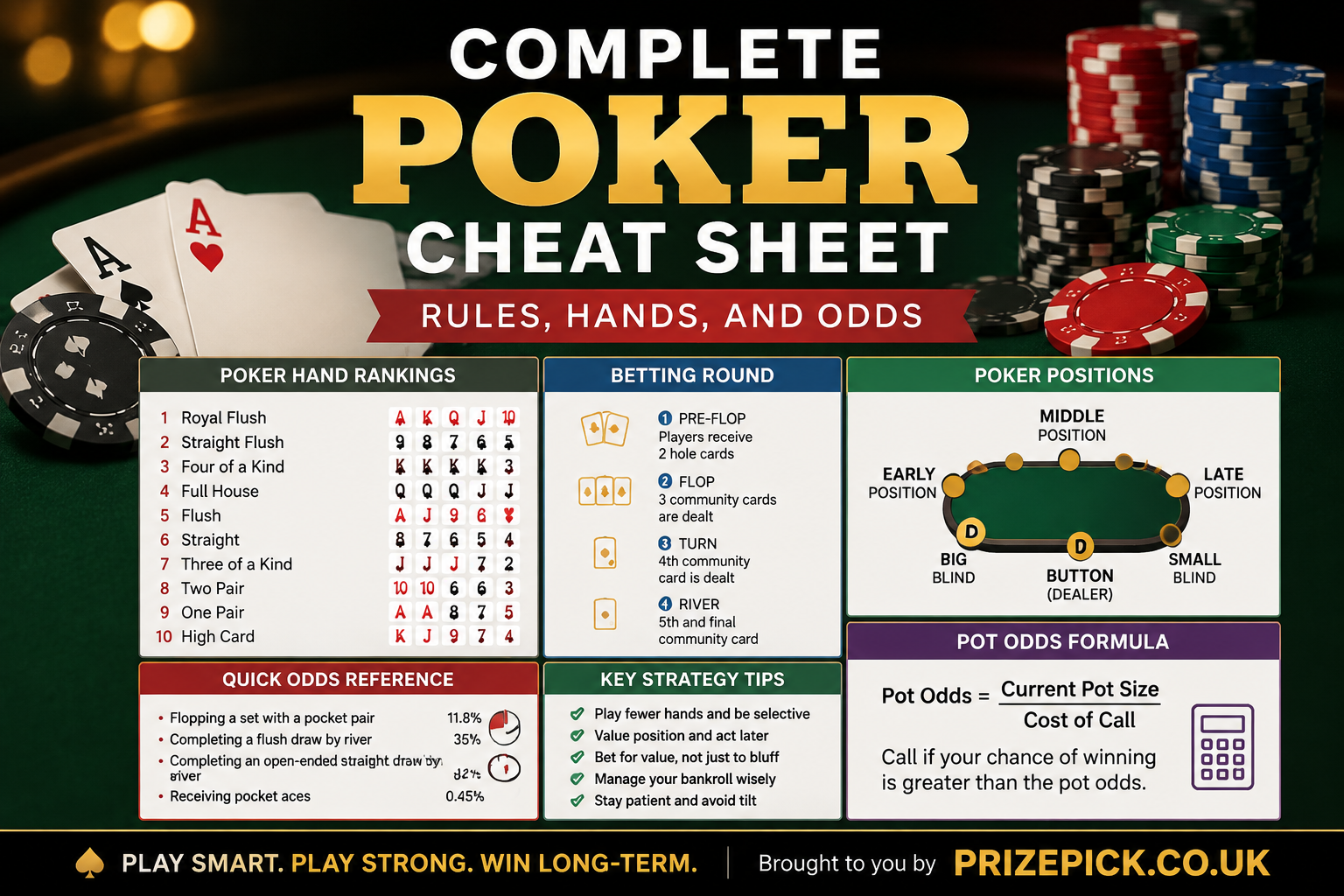
Whether you’re sitting down for your first poker game or looking to sharpen your decision-making, having a reliable Complete Poker Cheat reference can make learning much easier. Poker combines skill, probability, psychology, and discipline, making it one of the world’s most popular card games.
A good poker cheat sheet isn’t about cheating—it is a quick-reference guide that helps players remember hand rankings, betting actions, pot odds, table positions, and fundamental strategies while learning the game. Over time, these concepts become second nature, but beginners often benefit from having everything summarized in one place.
What Is a Complete Poker Cheat?
A Complete Poker Cheat is a learning guide that summarizes the most important poker information into an easy-to-read format. Rather than memorizing dozens of concepts at once, players can quickly reference key rules and strategies while practicing.
A quality poker cheat sheet typically includes:
- Poker hand rankings
- Betting actions
- Table positions
- Pot odds
- Starting hand selection
- Basic strategy
- Common poker terminology
It serves as a study aid rather than a shortcut to winning.
Basic Poker Rules
Although there are many poker variants, most follow similar core rules.
Objective
The goal is to win chips by either:
- Holding the strongest five-card hand at showdown.
- Making all opponents fold before showdown.
Standard Betting Actions
| Action | Meaning |
|---|---|
| Check | Pass the action without betting |
| Bet | Place chips into the pot |
| Call | Match another player’s bet |
| Raise | Increase the current bet |
| Fold | Give up the hand |
Every decision affects your long-term results, making disciplined play essential.
Poker Hand Rankings
Knowing hand rankings is the first skill every player should master.
| Rank | Hand | Example |
|---|---|---|
| 1 | Royal Flush | A-K-Q-J-10 (same suit) |
| 2 | Straight Flush | Five consecutive cards, same suit |
| 3 | Four of a Kind | Four cards of the same rank |
| 4 | Full House | Three of a kind plus a pair |
| 5 | Flush | Five cards of the same suit |
| 6 | Straight | Five consecutive cards |
| 7 | Three of a Kind | Three matching cards |
| 8 | Two Pair | Two different pairs |
| 9 | One Pair | One matching pair |
| 10 | High Card | Highest individual card |
Remember this order before learning advanced strategy.
Understanding the Betting Rounds
Texas Hold’em, the most popular poker variant, has four betting rounds.
Pre-Flop
Players receive two private cards.
Flop
Three community cards are revealed.
Turn
A fourth community card is dealt.
River
The fifth and final community card appears.
After the final betting round, remaining players reveal their hands during the showdown.
Poker Table Positions
Your position greatly influences strategy.
| Position | Advantage |
|---|---|
| Early Position | Least information available |
| Middle Position | Moderate flexibility |
| Late Position | Most information before acting |
| Button | Best overall position |
| Small Blind | Forced bet before cards |
| Big Blind | Largest forced bet |
Playing more hands in late position is generally considered one of the strongest beginner strategies.
Best Starting Hands
Premium starting hands give players the greatest advantage before the flop.
Premium Hands
- AA
- KK
- AK suited
- JJ
Strong Hands
- TT
- AQ suited
- AJ suited
- KQ suited
- 99
Play Carefully
Hands like small pairs, weak aces, and unsuited connectors require more experience and favorable table conditions.
Poker Odds Cheat Sheet
Understanding probabilities helps players make profitable decisions.
| Situation | Approximate Odds |
|---|---|
| Pocket pair before flop | 5.9% |
| Flopping a set with a pocket pair | 11.8% |
| Completing a flush draw by the river | 35% |
| Completing an open-ended straight draw by the river | 32% |
| Receiving pocket aces | 0.45% |
These figures are approximate but useful for making informed betting decisions.
Pot Odds Explained
Pot odds compare the size of the current pot to the cost of calling a bet.
Example
- Pot = $100
- Opponent bets $20
- Total pot becomes $120
- Calling costs $20
Your pot odds are 6:1.
If your chance of improving your hand is greater than the required percentage, calling may be mathematically correct.
Basic Poker Strategy for Beginners
Winning poker consistently starts with disciplined fundamentals.
1. Play Fewer Hands
Many beginners lose chips by playing too many weak hands.
Instead:
- Fold poor starting hands.
- Wait for stronger opportunities.
2. Value Position
Acting later gives you more information about opponents’ decisions.
Late position allows:
- Better bluffing opportunities
- More profitable value bets
- Easier decision-making
3. Bet for Value
When holding a strong hand, focus on extracting chips rather than slow-playing too often.
4. Bluff Selectively
Successful bluffs depend on:
- Board texture
- Opponent tendencies
- Table image
- Position
Frequent bluffing usually becomes expensive.
5. Protect Your Bankroll
Good bankroll management keeps variance from ending your poker journey.
A common guideline is never risking a significant portion of your bankroll in a single session.
Common Poker Terms
| Term | Meaning |
|---|---|
| Pot | Total chips being contested |
| Blind | Forced bet before cards are dealt |
| Board | Community cards |
| Kicker | Side card used to break ties |
| Nuts | Best possible hand |
| All-In | Betting all remaining chips |
| Showdown | Final comparison of hands |
| Outs | Cards that improve your hand |
Learning this vocabulary makes strategy discussions much easier to follow.
Common Beginner Mistakes
Avoiding these mistakes can improve your results quickly.
Playing Too Many Hands
Patience is one of poker’s greatest strengths.
Ignoring Position
Position often matters more than beginners realize.
Chasing Every Draw
Not every draw deserves a call.
Always compare your poker cheat sheet odds with the pot odds available.
Bluffing Too Often
Strong players choose their bluffing spots carefully.
Letting Emotions Control Decisions
“Losing tilt” causes many unnecessary mistakes.
Take breaks if emotions begin influencing your play.
Sample Beginner Decision Guide
| Situation | Recommended Action |
|---|---|
| Premium hand in early position | Raise |
| Weak hand in early position | Fold |
| Strong hand in late position | Raise |
| Small pocket pair | Play selectively |
| Weak offsuit cards | Usually fold |
This simplified guide helps new players develop disciplined habits.
Tips to Improve Faster
Improvement comes through consistent practice and honest self-review.
Consider these habits:
- Review your played hands regularly.
- Focus on decision quality rather than short-term results.
- Learn basic probability and pot odds.
- Observe experienced players.
- Stay patient during losing sessions.
- Avoid emotional decisions.
- Continue studying poker strategy over time.
Remember that poker rewards long-term discipline more than short-term luck.
Frequently Asked Questions
1. What is a poker cheat sheet?
A poker cheat sheet is a legal learning reference that summarizes hand rankings, betting rules, odds, positions, and basic strategy to help players improve their understanding of the game.
2. Can I use a poker cheat sheet during a game?
In casual home games, this depends on the house rules. In most casinos and competitive tournaments, outside reference materials are generally not permitted while actively playing.
3. What is the strongest poker hand?
A Royal Flush is the highest possible poker hand. It consists of Ace, King, Queen, Jack, and Ten of the same suit.
4. Why is table position important?
Players acting later receive more information about opponents’ actions, allowing them to make better strategic decisions.
5. How important are poker odds?
Poker odds help determine whether calling, betting, or folding is mathematically profitable over the long run.
6. Should beginners bluff often?
No. Beginners usually perform better by focusing on solid starting hands, value betting, and disciplined decision-making before incorporating frequent bluffs.
7. Is poker mostly luck or skill?
Luck influences individual hands, but skill has a much greater impact over many sessions. Strong decision-making, probability, and discipline separate successful players from casual ones.
Conclusion
A Complete Poker Cheat guide is one of the most useful learning tools for new and improving players. By understanding hand rankings, betting rules, table positions, pot odds, and basic strategy, you’ll make better decisions and develop stronger habits at the table.
Remember that poker is a game of long-term skill rather than short-term results. Study the fundamentals, play patiently, review your decisions, and continue building your knowledge over time. With consistent practice and disciplined play, you’ll be well prepared to enjoy the game while steadily improving your performance.