
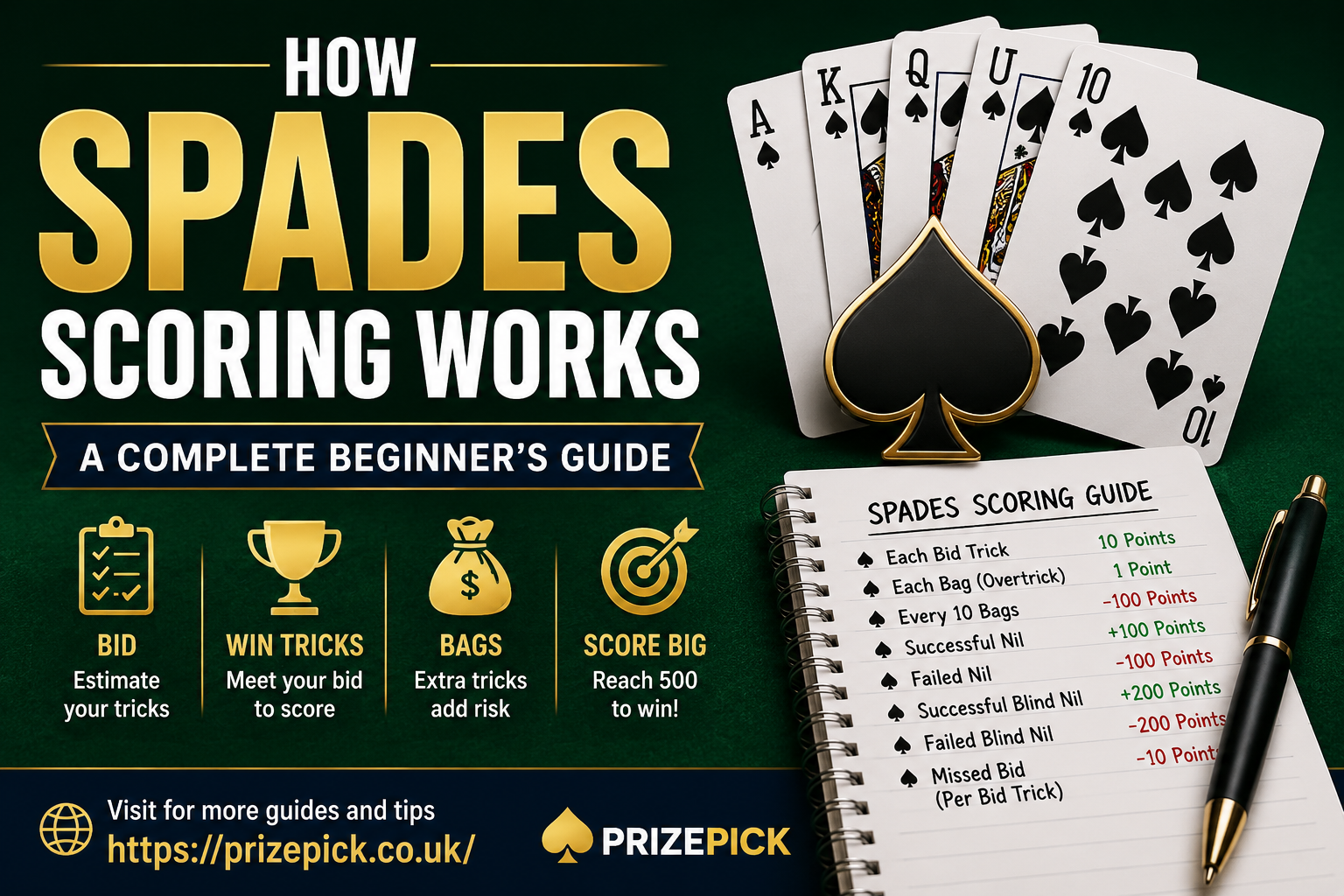
If you’re new to the card game Spades, understanding Spades scoring is the key to playing confidently and winning consistently. While the rules of play are relatively simple, the scoring system introduces strategy, risk, and teamwork that make the game exciting.
Many beginners feel confused by terms like bids, bags, nil, and penalties. That’s completely normal. Once you understand how points are calculated and how mistakes affect your score, the game becomes much easier—and far more enjoyable.
What Is Spades Scoring?
Spades scoring is the system used to track points in the game of Spades, typically played by four players in two teams. The goal is to reach a predetermined score (commonly 500 points) before the opposing team.
Each round, players estimate how many tricks (hands) they will win. This estimate is called a bid, and scoring depends on how accurately teams meet their combined bids.
How Bidding Works in Spades
Before cards are played, each player declares how many tricks they expect to win. Teammates’ bids are combined into a team total.
Example:
- Player A bids 3
- Player B bids 2
- Team bid = 5 tricks
The team must win at least 5 tricks to earn points.
Basic Spades Scoring Rules
Understanding the basic point system is essential.
Points for Meeting Your Bid
- Each bid trick = 10 points
- If your team bids 5 and wins 5 tricks → 50 points
Overtricks (Bags)
- Each extra trick beyond your bid = 1 point
- These are called bags
Example:
- Bid: 5 tricks
- Tricks won: 7
- Score: 50 (bid) + 2 (bags) = 52 points
What Are Bags and Why Do They Matter?
Bags might seem like a bonus, but they come with a hidden risk.
Bag Penalty Rule
- Every 10 bags = -100 points penalty
Example:
- Team accumulates 10 bags over several rounds
- They lose 100 points from their total score
Why Bags Matter
- Too many bags can erase your progress
- Skilled players aim to avoid unnecessary overtricks
Nil and Blind Nil Scoring
Nil bids add excitement and strategy to Spades scoring.
Nil Bid
A player predicts they will win zero tricks.
- Success: +100 points
- Failure: -100 points
Blind Nil Bid
A player declares nil before seeing their cards.
- Success: +200 points
- Failure: -200 points
Example:
If a player successfully completes a nil bid while their partner meets the team bid, the team gains a significant advantage.
What Happens If You Miss Your Bid?
Failing to meet your bid results in a penalty.
Rule
- If your team bids 5 but wins only 4 tricks:
- Score = -50 points
Key Insight
Missing your bid is more damaging than collecting a few extra bags. This is why accurate bidding is critical.
Spades Scoring Table (Quick Reference)
| Situation | Points |
|---|---|
| Each successful bid trick | +10 points |
| Each extra trick (bag) | +1 point |
| Every 10 bags | -100 points |
| Successful nil | +100 points |
| Failed nil | -100 points |
| Successful blind nil | +200 points |
| Failed blind nil | -200 points |
| Missed bid | -10 points per bid trick |
Example of a Full Round
Let’s walk through a simple scoring scenario.
Scenario
- Team A bids 6
- They win 8 tricks
Calculation
- Bid points: 6 × 10 = 60
- Bags: 2 × 1 = 2
- Total score = 62 points
Another Scenario
- Team B bids 4
- Wins only 3 tricks
- Score = -40 points
Strategies to Improve Your Spades Scoring
Understanding scoring is only half the battle. Applying strategy makes the difference.
1. Bid Realistically
Avoid overestimating your hand. Missing your bid costs more than gaining a few extra points.
2. Manage Bags Carefully
Try not to accumulate unnecessary tricks. Keep track of your team’s total bags.
3. Use Nil Strategically
Attempt nil only when your hand is weak and your partner can cover you.
4. Communicate Through Play
Since direct communication isn’t allowed, your card choices signal strength to your partner.
5. Track the Score
Always know your team’s score and bag count. This helps you adjust strategy mid-game.
Common Mistakes Beginners Make
Many new players misunderstand Spades scoring at first.
Frequent Errors
- Overbidding and missing targets
- Ignoring bag penalties
- Attempting nil too often
- Not tracking cumulative bags
- Playing too aggressively without strategy
Avoiding these mistakes will quickly improve your performance.
Why Understanding Spades Scoring Matters
Spades is not just about winning tricks—it’s about winning smart. The scoring system rewards precision, teamwork, and long-term thinking.
Players who understand scoring deeply can:
- Make better bidding decisions
- Avoid costly penalties
- Use advanced strategies like nil effectively
- Control the pace of the game
Frequently Asked Questions
1. How many points do you need to win Spades?
Most games are played to 500 points, but this can vary depending on house rules.
2. What is a bag in Spades scoring?
A bag is an extra trick won beyond your bid. Each bag adds 1 point but contributes toward a penalty at 10 bags.
3. Is nil always worth the risk?
No. Nil is high-risk and should only be used when your hand is very weak and your partner can support you.
4. What happens if both teams miss their bids?
Both teams receive negative points based on their bids.
5. Can you lose points even if you win tricks?
Yes. If you fail to meet your bid, you lose points even if you win several tricks.
6. Do bags reset after a penalty?
Yes. After reaching 10 bags and receiving a -100 penalty, the bag count resets to zero.
7. What is the difference between nil and blind nil?
Nil is declared after seeing your cards, while blind nil is declared before seeing them and offers higher rewards and risks.
Conclusion
Mastering Spades scoring is essential if you want to improve your game and play with confidence. While the system may seem complex at first, it becomes intuitive once you understand how bids, tricks, bags, and penalties interact.
The key is balance—bid accurately, avoid unnecessary risks, and use advanced strategies like nil wisely. With practice, you’ll not only track scores easily but also make smarter decisions that lead to consistent wins.
Whether you’re playing casually with friends or aiming to sharpen your competitive edge, a solid understanding of Spades scoring gives you a clear advantage at the table.